
After years of working in the advertising and signage industry, the most challenging and thought-provoking issue is undoubtedly quality control for illuminated signs. The illuminated signs we produce—whether three-dimensional channel letters, stylish LED neon signs, or various light boxes—all share one common feature: small-batch and customized production. Quite often, one style is only made once. Such a “one-off” production model cannot achieve full standardization and mechanization like assembly-line products, which poses a considerable challenge to quality management.
Many peers have asked me: How do you manage quality? To be honest, our method is not complicated; it can even be called simple. So simple that it can be summarized in a few key points.
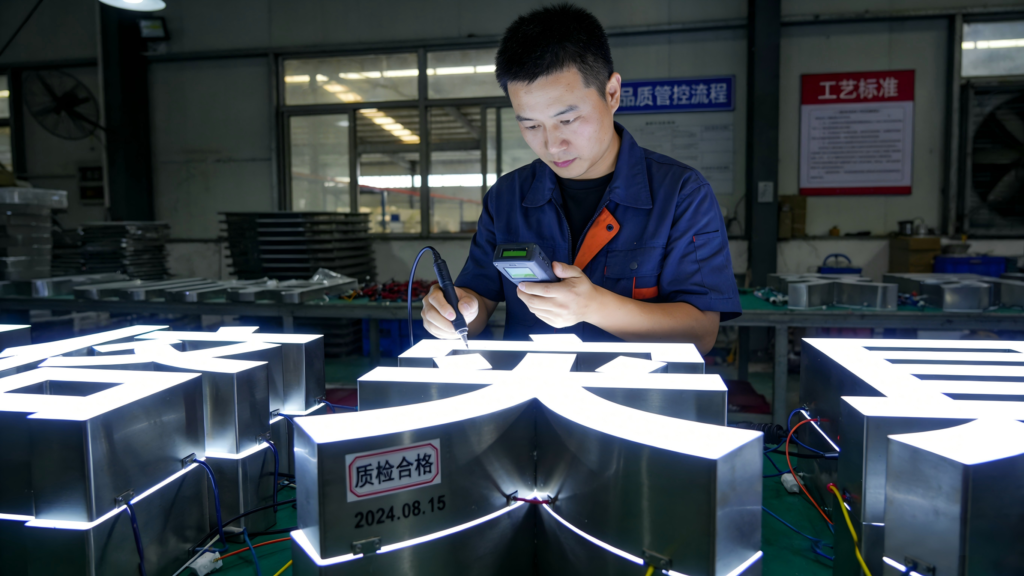
First and most importantly, it is attitude. I have always believed that attitude plays a decisive role in how well something is done. You can choose to muddle through and cut corners—after all, customers may not understand the details, and you can repair it later or simply ignore problems if it breaks down. Or you can choose to take it seriously and strive for excellence. These two attitudes determine the final quality of the product.
The attitude I am talking about starts with the operator’s attitude. As factory operators, we must have a clear vision: Are we here to make quick money through one-off deals, or to adhere to long-termism and take the long view? We chose the latter. Only by sticking to long-termism will you cherish your reputation, treat every product as your business card, and produce it earnestly. Because you know that customers are not fools, and the market does not close after just one transaction. A good reputation is our most valuable asset.
A good attitude from the operator alone is far from enough. You must turn this attitude into the attitude of the entire team. After all, the work is done step by step by the employees. How to convey this? We have two key tools. One is “profit sharing”, letting everyone understand that the factory’s performance is closely linked to each person’s efforts. When quality is well-maintained and customers are satisfied, everyone’s income will rise accordingly. The other is “strict systems”: good is good, bad is bad, with clear standards and clear rewards and penalties. Only by combining these two can we ensure that everyone works toward the same goal, and that the quality standards you want are truly implemented in every link and every process.
Another point is our attitude toward upstream suppliers. Many factories treat suppliers as adversaries, pushing prices down desperately, wishing the other side makes no profit at all. But we see it differently. Upstream materials and services are the source of our product quality. The sheets, light sources, and power supplies you use are all part of our final product. If suppliers do not have reasonable profits, how can they guarantee the stability and quality of materials? Therefore, we are willing to maintain good cooperative relations with suppliers, without deliberate exploitation, so that all parties can benefit. This shared attitude often brings more stable material quality and priority supply support, which in itself is a guarantee for our product quality.
Having talked about attitude as the “software”, let’s turn to the “hardware”—the quality of raw materials and components. When you take apart an illuminated sign, it basically consists of core materials such as stainless steel, acrylic, LED strips, and power supplies. Yet the quality of these materials directly determines the final effect and service life of the finished product. Some factories use inferior stainless steel to cut costs, which may rust within a year or so; they use cheaper LEDs, which suffer severe brightness decay and soon start flickering. The product looks shiny and attractive when newly made, but customers keep encountering problems during use. This is a typical case of sacrificing quality for profit. We have seen too many such examples. On the surface, money is saved, but in reality, what is lost is customer trust and long-term business. Therefore, when it comes to raw materials, we insist on using high-quality materials. This is our bottom line.

Ultimately, a great product is like a fine horse. With a good horse (high-quality raw materials), you also need a good saddle (the responsible attitude and craftsmanship of our entire team), and an excellent rider (consistent quality standards and systems) to control it. The combination of these three forms an unbeatable team.
So you see, our quality control experience is really quite simple: a correct attitude and good materials—that’s it. But to uphold these simple principles day after day, year after year, and implement them perfectly in every small-batch, customized order, is not simple at all.